
Author: messybunmezzo

A modern mezzo-soprano in her mid-twenties manages musical musings and miscellaneous mischiefs.

Review- Dvořák’s Rusalka at Opera Arlington

Performance Friday, February 2nd

Review Published Monday, February 5th

Edited February 6th to credit pianist Ivan Rustandi, The Cat, Hadassah Misner, and to correct the timing of the set change between Act II and Act III. Special thanks to Stage Manager, Martin Wells, for providing me with updated information!

Antonín Dvořák’s opera, ‘Rusalka,’ presented Friday, February 2nd by Opera Arlington, seamlessly merged the ethereal with the tangible. The anticipation among the pre-show crowd was only a precursor to the visual and auditory feast that awaited within the walls of Tate Springs Baptist. As the lights dimmed and the first notes resonated, the stage came alive with a set that masterfully navigated the boundaries of reality and fantasy. This show was directed by Eliza Escalante, and is a long time favorite of Opera Arlington founder, Dr. Bree Nichols. Please note that I will alternately refer to Dr. Nichols as “Bree” and “Nichols,” as her husband, Jason Nichols is also part of the production and I wish to avoid confusion. 

Before diving into Rusalka, I think a note about Opera Arlington is important. Bree Nichols founded the company when she noticed the number of talented young artists in DFW who, if in Europe, would likely be pursuing professional performing careers. However, the current structure of the US opera career path often leaves these artists caught between the Pay to Sing/Young Artist Program circuit and a fully professional career. Despite many of these young professionals holding graduate degrees and professional experience, many struggle to find work due to the limited presence of small companies. Opera Arlington, through productions like Rusalka, pays local artists fees while expanding their resumes. Though artist fees are currently modest, there is hope that, with more successful shows, the company’s profits will grow, allowing for increased contract fees. Nichols’ vision of a company casting local talent without charging for opportunities is a refreshing addition to the opera scene.

I was thrilled to note that ticket sales for Opera Arlington’s Rusalka greatly exceeded expectations set by their first production. Opera Arlington has recognized and capitalized on a gap in the market. The cast, comprised predominantly of young artists, reflects a positive trend for the arts, particularly opera. I am 31, and the folks in this production are my friends, colleagues and peers, all with graduation dates not far off from my own. This youthfulness, coupled with a fresh and lively performance, bodes well for the vibrancy of the arts scene fostered by Opera Arlington.

Pre- show, the crowd was very chatty, and the room was filled with oohs and ahs as folks entered and saw the set, which took maximum advantage of the performance space at Tate Springs Baptist. As patrons entered the performance space, a track of pond and forest sounds played over the speakers while lighting was programmed to give the illusion of water in the “lake,” and small laser effects were used to give the impression of bugs and other floating objects. 

The stage at Tate Springs is a small thrust, with doors upstage right and left that were likely originally meant for choir members to file onto risers. In this case, the risers have been replaced with stairs. On stage right, a set of palace stairs led down to a waterside terrace, the boundaries of which were defined by stone work columns topped with flickering lanterns. The stage left stairs descended from a hill in the forest, which was an excellent choice, and a window cut into the center of the wall between them served alternatively as Ježibaba’s hut and a palace balcony. I was excited to see this space used in this production, and it was used well. Directly in front of the stage, there is a small empty area that was used as the water. Large floral arrangements and clever lighting made for a very believable lake, and I am delighted with how well it all read from out in the audience. 

Unlit Christmas trees filled the auditorium and one felt surrounded by the pine forest. Of all the trees, only one was regrettably placed- the full and bushy conifer placed downstage left obscured the view of the stairs. I was seated in the center stage section a little more than half way back, and I missed a good bit of the staging in that area. I had at this point moved seats two different times trying to find a spot that gave a good view and would allow me to scribble notes without distracting other patrons. I had happily settled on this center section aisle seat in a mostly empty row, and this would have been ideal had a group of five not walked in 3 minutes before the scheduled downbeat. They happily squeezed in next to me and I found myself very squished, although still eager for the show to start. By now, the sanctuary was absolutely packed with patrons and there was no place left for me to move. Attendance was easily double the size of either crowd that came out for Così fan Tutte, Opera Arlington’s first show, this past Spring. There were so many in attendance that by intermission, the place had grown very warm. 

The chorus was strong and lively, and when they sang from off stage, they were placed on the balcony, up and behind the audience. This worked very well, as they were always together and with the conductor. I do not know nearly enough about Czech diction to tell you whether or not the language was correct, but Bree is a Czech expert and an excellent teacher. Having recently done a Czech diction coaching with her myself, I am confident the chorus did well. 

The orchestration was a chamber ensemble led by Jason Lim, director of the McKinney Philharmonic. Although the orchestra was thin and timid at times, it was absolutely the right choice to use a chamber ensemble for this show. Dvořák’s use of the harp is so necessary to create the watery musical effects, a piano reduction just couldn’t have done the score justice. The brass did not overpower the strings, but to be truthful, I think the strings could have been more aggressive. The cadence at the end of Act II was so tepid that I wasn’t sure it was the final cadence. I did occasionally feel that singers were holding back for fear of overpowering the orchestra, but it was the orchestra that should have been adjusting to the singers.  Although I would like to acknowledge that rehearsal time was short, it would have been nice to have a more confident chamber ensemble. I would also like to note that it was announced before curtain that the pianist was a last minute replacement. The piano seemed well played to me, but replacing someone last minute can certainly change the vibes of a musical group, so take my criticism with a sprinkle of salt. 

[Edit February 6th: I think it’s important to be able to change your opinion when you are presented with new information, and I am glad that I wrote to take my opinion here with a sprinkle of salt! A crew member reached out to let me know that rehearsal time was more than limited- it was scarce indeed! One orchestra rehearsal, followed by two sitzprobe the very next day would have left me feeling absolutely overwhelmed if I was the one prepping for a show. There were also unforeseen circumstances that led to the last minute replacements of more than one musician, and with that in mind, I think it’s very impressive what the orchestra was able to do. I mentioned I thought the piano played well, and I would like to reiterate knowing that the pianist was not just a replacement, but a sub who jumped in at Final Dress Rehearsal! It seems that pianist Ivan Rustandi is the unsung hero of this production!]

As for the singers, I have much praise to give, and I will certainly touch on that later. A note throughout, however, is that knowing the music you don’t sing is just as important as knowing the music that is assigned to your role. Specifically, the transitions and pauses on either end of a line you have to sing. I will praise all day a singer who actually does watch their conductor, which this cast did, and it made for a better production, but it takes you out of the moment when a singer stares down the conductor for six to eight bars waiting for their cue.

The opera opens at dusk on the banks of the water with three Wood Sprites teasing the water goblin, Vodník, king of the lake. Sophia Formella, Megan Dobbs, and Madeleine Fell were an adorable trio, well rehearsed and blended, three parts always audible. The choice to costume them in white amongst a set and lightning full of greens, blues, and purples, made them glow. They wore capes of shimmering pleated organza, strung with lights that made them seem like gossamer fairy wings. They wore the flowered headdresses of unmarried women that seemed to be inspired, like much of the show, by the paintings of Czech artist Alfons Mucha. I could not get enough of these ladies or their costumes, and they set my expectations high for the rest of the show. I think there is often an idea that such trios in opera are for lesser singers, and that is simply not so. Much like the three ladies in Magic Flute, this trio serves an important narrative purpose, moving the plot along and giving us context, and the singers knocked this ensemble out of the park. 

Vodník, performed by Tres Hunter, appeared in a ghillie suit that had been enhanced with touches of shimmery ribbon, and large minnow shaped fishing lures entangled throughout his mossy limbs caught the light and added to the shimmery, underwater look. Tres moved with heavy, lumbering motions, as if he were actually dripping water every time he came up and out of the lake. Hunter has a beautiful, warm, lyric quality to his voice that made for a very pleasing Vodník. At times simply booming out over the rest of the cast, Hunter is a young bass to keep up with. 

Two large projection screens served the dual purpose of displaying supertitles and adding backgrounds for the set. A beautiful digital painting of a full moon was displayed stage left as Rusalka entered in an enormous headdress, veil, and cape, which she expertly used to swim around the stage. She wore a beaded blue mermaid style gown to complete the ensemble. A watery vision, Nichols voice rang like a bell as she cried to Vodník of her love for the human prince. Vodník reluctantly refers her to the witch Ježibaba, warning her she may not like what happens. Nichols’ Song to the Moon was incredible. Good technique and good acting combined for a stunning experience, and I am sorry to say that if you were absent, you missed a treat. I especially appreciated her reaction to the magic motif in the middle of the aria. She frantically searched the water for the prince as the repeated notes came from the orchestra, and it seemed as if the moon heard her cry and began to work on her plaintive pleas. I frequently find that even in productions put on by big houses, directors and singers forget that the sound effects are provided right there in the music. The entire cast of this show made good use of the music, allowing it to dictate their movements and actions.

Rusalka’s cries for Ježibaba’s help were so sad and endearing, and I was feeling quite a lot of pity for her when Sabatina Mauro took the stage by storm. Mauro is an absolutely arresting stage presence and an unforgettable mezzo. She completely embodied the hedge witch Ježibaba as she walked the twilight between the spirit world and the world of Man. Nichols’ petulant cries for help were met with bemusement at best, derision at worst, and Mauro’s vocal agility almost made me forget who I was supposed to be rooting for. Mauro reached for the projection, seemingly drawing energy from the moon to fuel her spellwork. 

The directors made the risky decision to give this witch a cat. I am normally averse to having humans play animals in this kind of production, but I have to say, I thought the added role was extremely clever. I am not sure the name of the young woman who played the cat, as I could not find it online or in the program, but she was a delight. [Edit February 6th: I am delighted to learn that The Cat was played by the off night Turnspit, Hadassah Misner! ] [Misner] wore all black, cat ears, black gloves, a tail, and black make up to show a cat’s nose and whiskers. She prowled around Ježibaba helping to work the spells and brew the potions that Rusalka begged of them. This allowed Ježibaba to remain on stage with Rusalka as the two women exchanged melodies, the window on the back wall lit up with oranges, reds, and yellows as The Cat danced around a cauldron, gleefully carrying out the messy business. 

Damnation certainly sounded enticing as Rusalka drank the potion. Ježibaba and The Cat snatched away her headdress, veil, and wings as the hunting horn sounded from the orchestra. Vodník mourned Rusalka’s bad decision making from off stage and Nolan Brown entered as the Hunter/Gamekeeper. Brown was charming, delivering a beautiful arietta before the onstage arrival of The Prince.

Unfortunately at this point, there were still patrons trickling in looking for seats, which was very distracting. Rusalka and The Prince were on stage together by the time everyone arrived and found their seats. It would have been nice to have had a screen in the lobby displaying the action for latecomers, who really should not have been allowed to be seated so late into Act I. 

Jason Nichols as The Prince is a clear and vibrant tenor, easily winning the audience’s favor as he searched for a white doe. He was dressed all in browns, and the happy coincidence of his red hair made his physical appearance very warm, which was in pleasing contrast to his wife and counterpart Bree, who made good use of blue and purple contour make-up to give her entire body the look of being cool and cold. The couple’s on stage chemistry was, of course, palpable. As the prince found Rusalka and decided to take her away with him, a chorus of water nymphs lamented from the balcony, sounding the alarm, “Sisters! One of us is missing!” Rusalka’s reaction to their alarm elicited panic in my heart, and Act I came to a close as she made the decision to follow the prince. 

Act I clocked in at just under an hour, and was very well paced. As patrons filtered in and out of the performance space, the set was changed from Spring to Fall. Floral arrangements were swapped out and the terrace was set for a party. The two large projection screens displayed artwork including Mucha’s paintings of The Seasons. As I stepped outside into the rainy evening to cool off, I was happy to greet friends and chat with folks in the lobby. We slowly found our way back inside as the lights dimmed for Act II. 

Nolan Brown appeared again as the Gamekeeper, and this time, he had with him his niece, a turnspit/kitchen maid, sung by mezzo-soprano Kelsey Korman. The pair made for a gossipy duo, telling the audience how much time had passed and setting the scene for the upcoming party, telling us that the Prince is planning to marry a mute and nameless girl who showed up out of nowhere. They speculate demons and witchcraft, with the Gamekeeper teasing the Kitchen Maid. Korman is a great character actress, coming across as playful and enthusiastic. I loved Brown and Korman together in this scene. They played very well off of one another and although they serve as foils in the plot, I couldn’t help but like them. 

A Foreign Princess, played by Dr. Erica Simmons, is a wedding guest, and The Prince is showering her with attention. Simmons appeared in stark contrast with Nichol’s Rusalka, portraying a passionate and fiery princess. Ringing highs and sumptuous lows from Simmons curse the Prince and Rusalka as The Princess makes it clear that The Prince belongs with her. Her scorn actually wins The Prince, who rejects Rusalka. Bree’s acting in this scene was incredible, displaying a woman desperate for the Prince’s love but too timid to fight for it when his attentions turn elsewhere. At one point, she was provoked by The Princess and she lunged in a hissing attack, hands outstretched as if they were claws, reminding us that she is not quite human. As The Prince led The Princess off stage, Rusalka made pitiable attempts to regain the Prince’s attention. Failing this, she returned to the water below the terrace and cried out for Vodník, who has until now, been traipsing about the scene unseen by partygoers. A rumble proceeds his musical entrance and the wedding guests gasp in horror as the water goblin becomes visible. I loved this detail, and would like to congratulate the chorus, whose singing was so beautiful, for ignoring Hunter so well until they were supposed to notice him. The scene ended with a storm as Vodník cursed the party, and the lights came down amidst thunder and lightning effects.

The scene change from Act II to Act III took too long, almost three minutes. The thunder storm sounds stopped and we were left in silence for a solid two minutes while the scene changed from Fall to Winter. The set change mostly consisted of removing party decorations such as chairs and tables and covering the floral arrangements with white cloth to imitate snow. It would have been much faster and more efficient for each chorus member to exit with a set piece than to leave it all for the scene change. I find it easier to suspend my disbelief for a scene change where chorus members each take a chair, and a tablecloth is moved to a bush than it is to sit for so long while only two or three stage techs are left to handle it on their own. If three minutes are truly necessary for the change, it would be nice to give the orchestra some transition music to play. This could be a revamp of music that has already happened, or even a folk song selection from Dvořák’s many other works. 

[Edit February 6th: Here I would like to add a lengthy correction. I am a time blind individual who uses clocks and alarms in excess to keep my life moving and be places on time. This has caused me to become an obsessive Watch-Checker. While I was in attendance Friday night, I checked my watch at the end of Act II and at the beginning of Act III, noting that three minutes had passed from cadence to lights up. It did not occur to me at the time that this could have meant that a 60 second window with 15 seconds on either side would appear the same as 3 minutes if I wasn’t using a timer. I would like to sincerely thank Stage Manager Martin Wells for reaching out to me to ask about this. He let me know that the stage team had actually clocked the scene change at about 90 seconds, and it was the fastest of the entire run. While sitting in the silent dark felt like a long time to me personally, I would like to make sure that readers know that this was a me problem and I was wrong, and that the scene change did not take three entire minutes, rather 90 seconds that occurred during three separate minutes.] 

Rusalka made her Act III entrance in a veil that covered her entire upper body, including her face, and carried a blue light. The veil itself was gorgeous, with iridescent glimmers throughout that showed beautifully in the stage lighting, but it was, in my opinion, too opaque. Most of the light bounced right off of it, and you couldn’t see her face at all, which I think is a shame because Bree is so expressive. Perhaps this was intentional, and I love the look they were going for, but I think a more delicate, more see-through fabric would have been a nice alternative. 

Rusalka meets with Ježibaba and begs for a solution to her problems. The witch offers a chilling solution. She hands the disconsolate water nymph a knife, and reveals that Rusalka can save herself if she kills the Prince. Rusalka is horrified, and throws the knife into the lake. Nichols and Mauro are well matched throughout this scene. Ježibaba shows little pity as a chorus of water nymphs informs us that Rusalka is now a Will-o’-the-wisp, neither woman nor nymph, unable to live and unable to die. The women’s chorus was beautiful and haunting. Again, well blended and well rehearsed, I really felt this chorus added to the show. 

The scene changes as the Gamekeeper and the Turnspit come to beg Ježibaba for help getting rid of Rusalka, whom they believe betrayed the Prince and is responsible for his slowly going mad. The singing and comic timing throughout this scene were a happy reprieve from an otherwise depressing plot. I was, however, disappointed to miss the action between the Turnspit and Ježibaba, since it all took place directly behind the tree.

Hunter appeared again as Vodník, terrifying the humans and setting the record straight. The Gamekeeper and the Turnspit made a terrified exit, and the trio of Wood Sprites reappeared to mourn Rusalka’s fate. Their costumes had traded their headdresses for little white fur hats, acknowledging how much time has passed and that is now Winter, a detail I appreciated. In the scoring for this scene, the first and second Wood Sprites each get a solo, but I found myself irritated on behalf of the third, who surely also deserved a moment in the spotlight. Alas, Antonín Dvořák is dead and is not around to hear my defense of the mezzo-soprano. 

Finally, the Prince wandered back on stage in search of his white doe, stopping at the edge of the lake to call out to Rusalka. Jason Nichols sang this scene very well, and I felt his desperation as he called for his water nymph. Rusalka answered his call, finally able to speak to him. The Nichols’ broke hearts as they sang the final scenes, the Prince begging for a kiss, knowing it meant death, and Rusalka resolving to grant his wish. Vocally, Jason and Bree are a pretty pair. Bright, clear voices singing such dark thematic content was very unsettling, exactly the way I think this music should be presented. They kissed, and the Prince died begging for another. Rusalka then covers him with her mourning shroud, as the Wood Sprites return her original headdress and veil. I liked this staging very much. In a dark and unsettling way, it implies that in kissing the prince, Rusalka has killed him and thus fulfilled the terms of the contract with Ježibaba. Notably, she did not regain her “wings,” making it clear that she has lost an integral part of herself. Rusalka, wingless, exited directly down the center house aisle, deep, deep into the lake as the lights came down for the final time.

The house absolutely erupted with applause. This show is a shining triumph for Opera Arlington. 

Escalante’s production unfolded as a captivating journey, seamlessly blending ethereal storytelling with tangible performances. The meticulously designed set, clever use of lighting, and a chamber ensemble led by Jason Lim contributed to a visually and aurally stunning production. Character portrayals, from the whimsical Wood Sprites to the hauntingly powerful Ježibaba, were a highlight, with strong vocals and expressive acting leaving a lasting impression. While the orchestra’s chamber ensemble occasionally felt timid, the singers navigated their roles with passion. Noteworthy is Opera Arlington’s commitment to local talent, challenging the traditional opera career path, and its positive impact on the DFW arts scene. The production’s success solidifies Opera Arlington’s role as a vibrant contributor to the local arts landscape.

Follow Opera Arlington on Facebook to stay up to date with their performance calendar. Their second season has been announced, and will include a production of Cendrillon, a scarce performed show composed by Pauline Viardot, and Mozart’s Don Giovanni, a beloved staple of the operatic repertoire. 

If you were in attendance and noted any stand-out moments, please feel free to comment below!
A Review of Lawrence Brownlee in Recital with The Dallas Opera

Performance Sunday, January 21st at 2:00pm

Moody Performance Hall, Dallas, TX

World class tenor Lawrence Brownlee made his long awaited Dallas Opera debut yesterday afternoon with a program inspired by poets of the Harlem Renaissance. Brownlee partnered with celebrated pianist Myra Huang, their mutual musicianship captivating the audience which was already so excited to receive them. Despite the chill of the January afternoon, I was pleased to note the recital was well attended; the greetings of friends attending together and separately in the lobby made for a happy prelude.

Brownlee’s setlist features a rich variety of music, with an emphasis on Composers of Color and Millennial composers. The words of Langston Hughes were brought to life in two song cycles written by African-American composer Robert Owens. The program opened with Owen’s “Desire,” a cycle requiring equal parts intensity and lyricism. Brownlee and Huang were a well matched ensemble.

Brownlee opened the second set with an announcement that composer Jeremiah Evans (b.1978) was present to hear his works realized, and the composer was greeted with applause before the set began. “April Rain Song” and “Lost Illusions” were lovely pieces, with pleasing melodies and some welcome harmonic surprises, but the crown of this set was certainly found in “Southern Mansion,” set to text by Arna Bontemps (1902-1973).  An unsettling picture rose from the tinkling melody, representing the party inside the mansion, while a menacing bass line and bluesy harmonics drag you outside into the cotton fields as a real and heartbreaking reminder of the horrors that built the vast wealth of the American South. The set was met with raucous applause and shouts of “bravo” from throughout the hall.

It is worth noting that at this point in the afternoon, the exuberant audience was so very pleased with what they were hearing that set list etiquette was thrown out and almost entirely ignored. There was applause after nearly every piece, and although it was well deserved, it did threaten to slow the pace of the program to a drag. Pianist Myra Huang, however, did not let the noise keep her from swiftly and consistently moving on to whichever piece was next, a decision that served the program well. A simple solution would have been to simply remind concert goers that in a recital setting, applause is typically held until the end of a set. 

The third set featured five songs by Joseph Marx (1882-1964). Although Marx is neither a person of color nor a living composer, the songs fit seamlessly into the themes of the afternoon. While I did think it was odd to include only one set not in English, Brownlee sang the lieder with much attention to detail and excellent diction, demonstrating artistic as well as vocal range. His singing was an excellent reminder that well rounded singers typically focus on more than just role preparation. Brownlee’s command of the melody and the text resulted in a complete story told every two or three minutes, which is quite a challenge when an opera typically allows for two or three hours to tell a single tale. 

After intermission, Brownlee again broke the fourth wall to discuss the importance of connection and musical intimacy to remind us that it is humanity which creates a truly great recital setting. He opened the second half with one of three Vocalises by Carlos Simon. The transition worked well to remind us that even without words, we are capable of communicating great thoughts and emotions. Vocalise I was very traditional, calling to mind French melodies, soaring on an “Ah” to a beautifully sustained high note. Vocalise II was written to evoke Gospel vibes and made good use of dissonance. Vocalise III was certainly the most interesting of the group, including consonants and syllables not typically heard in such pieces. The vocal line wove in and out of the piano, which was equally important to the composition, and I found myself fighting the urge to tap my foot. 

Another composer was found to be present in the audience with the introduction of Jasmine Barnes (b. 1991). Barnes has an easy command of melodic storytelling and Brownlee certainly did that justice in his presentation of her songs, which despite being presented as a set, were both met with cheers. “Peace” is a truly beautiful song, full of hope, and an excellent opportunity to showcase Brownlee’s beautiful head voice, which was neither too light nor too heavy, but Barnes, like Evans,  is also best exemplified in the last piece of her set. “Invocation” was a stand out moment of the afternoon. Rhythmically masterful, Barnes did not have in mind a piano accompaniment, but an interaction between piano and voice. There were moments that seemed to almost resemble an habanera, and it was easy to be moved by Brownlee’s interpretation. 

Brandon Spencer (b.1992) is another Millennial composer refreshingly showcased. “I Know my Soul” and “The Dance of Love” were both groovy pieces, using syncopation and almost post-tonal harmonics to inspire the audience to dance as much as they could in their seats without disturbing their neighbors. Both poems were well set, and it was refreshing to see a singer actively communicating with their collaborative pianist during a performance rather than simply expecting to be followed. 

Brownlee next presented music by Damien L. Sneed (b. 1979). “Beauty that is Never Old,” “The Gift to Sing,” and “To America” continued the more gospel feel of the Spencer set. Brownlee changed the order of these songs to close with “The Gift to Sing.” With its high tessitura, it fits particularly well into Brownlee’s instrument. 

Perhaps the most interesting (certainly the longest) piece on the program was Shawn E Okpebholo’s “Romance.” Before beginning this piece, Brownlee asked the audience to think about what inspires them to come alive, and urged them to use their answer as motivation. “These songs are not just for People of Color,” Brownlee said. “There are a multitude of things in here for everyone, don’t hesitate to study these songs and make them part of the canon.” The piece he proceeded to perform was particularly challenging. I found myself in the audience desperate to find myself a copy. The tessitura, the intervals, evoked Stravinsky and Messaien. Head voice and falsetto flew in and out of these incredibly difficult passages. Although long, I would highly recommend a listen. Brownlee has recorded it and it is available on Apple Music. The sheet music can be purchased for $15 at www.shawnokpebholo.com and would be an excellent addition to any graduate recital, although it is likely too challenging for most undergraduate students. 

Closing out the recital sets are three songs by Joel Thompson (b. 1988). This set began somewhat introspective and serious, with “Supplication” playing almost as a prayer, and “Compensation” serving as an entreaty to use one’s gifts wisely. The last programmed piece, “My People,” soared over the crowd, bursting with clever compositional turns, sounding at some points of jazz, R&B, even of salsa! The words of Langston Hughes are set well in a song that joyfully encompasses the musical stylings of Black People in America. The laughing runs towards the end of the piece were contagious, eliciting giggles and laughs from the crowd as Brownlee seemed to express a very genuine joy in his singing and in Black Culture. The charming lyrics end:

Dream-singers,

Story-tellers, 

dancers, dancers, dancers, 

And loud-mouthed laughers in the hands…

Loud-mouthed laughers in the hand of Fate– My People!

Insistent applause drew Brownlee and Huang back for an encore. Due to the themes throughout the programmed music, I expected that Brownlee might present a Spiritual or Gospel selection, but of course, as a recital artist at the Dallas Opera, he chose to encore with an aria, and “Una Furtiva Lagrima” from L’elisir d’amore by Gaetano Donizetti was performed. A better interpretation has rarely been heard.

In response to the encore, a standing ovation was interspersed with murmurs and whisperings as fans hoped that Brownlee might perform a second encore, and all around the words were whispered, “Ah mes Amis?”

To my utter shock and delight, after having performed two hours of incredibly demanding music, Brownlee and Huang again returned to the stage and gave the people what they wanted. The audience was treated to a stunning rendition of “Ah Mes Amis” from La fille du régiment. It’s as if Donizetti had Brownlee in mind when he composed this aria. The absolute endurance necessary to have closed with this is astounding, but truth be told, Brownlee made it look easy. 

This is not the first time Brownlee has presented this recital, and I certainly hope it is not the last. It was a thought provoking and moving program, and as a Millennial myself, I was very pleased to see so many Millennial composers featured on the bill. Brownlee let us know that he had personally commissioned several of the pieces on the program and I think more of us should consider doing the same when choosing our own set lists. We spend an awful lot of time studying “the greats,” but truth be told, you can only hear so many interpretations of Lieder or Melodie before you start longing for something more contemporary, something fresh. Brownlee’s set list certainly ticked off those boxes for me, and I have already purchased a copy of “Romance.” I will be looking for reasons to perform it. 

My biggest complaint from the afternoon is that the second half of the program seemed slowly paced. I think one set could be easily eliminated for a better overall flow, but what would one cut? Each grouping was clearly chosen for a reason. As beautifully sung as it was, I think perhaps eliminating the German set and presenting a fully English language program would be the solution. Regarding Brownlee’s singing, I have only positive feedback to offer. 

Fans of classical music can look forward to the Hart Institute for Women Conductors Showcase Concert, which will take place on Sunday, January 28th at 7:30pm, and if you didn’t get enough German yesterday, The Dallas Opera will raise the curtain on Elektra on Friday February 9th.

It’s Like You’re Only in it for the Money

I sent an email to my private voice studio today detailing how we will move forward with learning during social distancing. It’s the third blanket email I’ve sent to my students and their parents since school closings began in my district. Not that it’s done any good at all, because I know that even though they all sign a form saying they understand our primary form of communication is email, half of these people don’t read a damn thing I write to them.

It’s why their children come to school without their sheet music, without having practiced, unaware of looming deadlines and concert dates, all things I take care to mention every time I see them. But most of all, it’s why they don’t pay me.

To explain what I do, again, because it’s confusing, I’m a private voice instructor at Allen ISD, the school district in a large, affluent, Dallas suburb. The school district does not pay me. Ever. For anything. Because, as they are so fond of reminding me, I am not an employee. I am a contractor. The students I work with each week pay me directly, and I have to report the income on a 1099 form every year. Or rather, my accountant, Eddie, reports my income on a 1099 form every year.

You can imagine how difficult book keeping becomes when you have 48 students, many of whom fail to notify me of their absences, and insist on refunds anyway, despite having signed my studio rules sheet which informs them that no such thing will happen. My absence policy is, in my own opinion, generous. According to the school district, I am not obligated to make up a lesson missed by a student if I don’t have notice. My policy is that students must notify me 24 hours before their lesson if they will be absent, or they forfeit the fee. I’m often lenient with this policy. Sometimes you don’t know if you’re going to be sick, or students don’t realize they are being pulled from class early to go to the orthodontist. Truly, if they text me an hour ahead of time, I usually just swap their lesson time with a classmate later in the week. My rules are there for ease of scheduling, but what they’re really about are respect for other people’s time. The joke is apparently on me, because I failed to account for a global pandemic in my absence policy.

My school district moved to online learning on March 23rd. Students were notified of this ahead of time by many people. My boss, one of the high school choir directors, even emailed students and their parents on March 16th that it is expected that students who can will continue voice lessons online, and to look for an email from their private instructor.

Not keen on the thought of losing even more income, I slotted 50 lesson times over the course of the week of March 16th, and toggled my teaching website’s settings so students could sign up for their own lesson times, as I do not know what their new online class schedule looks like. I sent an email instructing students how to sign up, and asked them to please follow up with their videoconference platform of choice. I even said that if a family can’t continue lessons at this time, to please just let me know. Two parents responded that their kids will resume lessons when school resumes. Great, thanks for telling me. Zero out the account and move on.

Eleven kids signed up. That’s 22%.

I was extremely disappointed, but I guess I understand. At that point, school had only been cancelled for a single week, and I am sure that most families just assumed they would get a refund. But here’s the thing- their teachers and I both told them that lessons were continuing online and they chose not to take advantage of that opportunity, or even let me know that they would have to stop lessons until school resumes. I have delivery receipts turned on, I know they all received my notice. If I’m that lenient on absences, surely I can be trusted to understand someone’s need to take a pandemic related hiatus.

Then came the announcement that school would be closed for another two weeks. On the 23rd of March, I sent another email, reminding students that according to the lesson contract they signed at the beginning of the year, lessons are a part of class, and like class, they would be taking place online. This week 22 signed up. I was relieved.

We are now at the end of the month. I typically send invoices for a given month a week before the 1st. For example, I would normally have invoiced April on March 23rd. However, since the world is currently the way that it is, I held off, trying to get as many kids as possible to sign up for lessons so that I wouldn’t have to go through every individual account and manually adjust balances to reflect credits. After deliberating for most of the week, I decided since Allen’s official statement is still that we will return to school this coming Monday, I would invoice April under the assumption that we will be in school.

Anticipating a series of complaints from parents regarding the balances on their bill, I sent a preemptive email. I stated that I would be invoicing April as planned, that families would receive one credit for the first week school was cancelled, but if they chose not to sign up for their online lesson the following week without telling me, they would be charged.

I sent the email.

I’m not kidding, ten minutes later I had four emails from angry parents, demanding that I refund their money.

I was told by one parent that it’s completely inappropriate to send an invoice for April, as Allen will clearly be extending the school cancellation. I don’t know what to tell her, as I was told to operate business as normal unless instructed otherwise. How do I respond to this? I mean, school will probably still be online. So lessons will also be online, and with her $80 charge she is entitled to four lesson slots. Just because we aren’t in a building doesn’t mean that school isn’t happening.

Another said that she demanded a refund, as it was not her fault she didn’t read my previous emails. ????? Yes it is????? It is literally your own fault that you saw my email and chose not to open it? Actions and inactions have consequences, if you receive an email from a real person, you should freaking open it. They probably sent it because they need written record of important communication.

My favorite, though, is the parent that responded that I had no compassion for families stuck at home in isolation. She said it was as if I were only in this for the money.

Folks, I really don’t even know where to start dissecting this. I guess the first thing to share is that I know the parent who sent this message. She is kind, cheerful, warm, and bubbly, and to receive such a note from her brought me to tears. I have no idea how to advocate for myself in this situation. In it for the money.

 I’m still teary eyed and stuffy nosed as I write this, but I have to say that from one perspective, that is absolutely laughable. I make about $40k each year as a graduate level professional in my field, and convincing people to pay me on time, or sometimes at all, is nearly impossible in the first place. I had to practically harass my last orchestra director before he mailed me a replacement check after trying to undercut my fee. I have parents who literally will not pay me until I call them on the phone and make them answer the PayPal request. In it for the money.

I know $20 for a half hour lesson sounds like $40 an hour, but really, it’s $20 multiplied by 48 students for each week they are in school, which this year was supposed to have been 35. That’s $33,600 from teaching private lessons in one school year, if there are no absences. My other income comes from my church job, and any paid gigs I happen to take. The front desk secretary at the middle school makes more money than I do, even though I am overqualified and underpaid. I wonder what this parent would say if I told her that my private rate is $30 for 30 minutes? I would argue that in the DFW metroplex, that’s a bargain. I’m good at what I do. I’m not arrogant, I know my worth, and I deserve to be paid on time and in full. In it for the money.

From another perspective though, the arts are a very difficult industry. Very few earn all of their income performing, and most supplement with teaching. For many musicians I know, the majority of their income arrives via their students. Even most successful performers I know in their 40’s and 50’s hold professorships at a nearby university. If only a doctorate were free, I’d study the hell out of that, add DMA to my MM and BA, and level up to a salary and benefits. Teaching is how I make rent, pay my bills, keep my paltry insurance coverage. Up until quite recently, I’ve counted myself amongst the few lucky and successful musicians in my demographic. Late 20’s, performs frequently, has a financial safety net because of her teaching studio, makes all of her money doing jobs and activities directly related to her degree. I have enough saved to last me about two months. Success in the classical music industry does not always equate to fame. Sometimes it equates to earning a stable living.

I am absolutely in teaching for the money, and that does not make be a bad person, or a bad teacher, or sellout performer. My students are awarded Outstanding Soloist at district competitions, gain admittance into magnet schools for the arts, sing leads in both school musicals and outside productions, participate in the Dallas Children’s choir. They place in talent shows and participate in family friendly open mic nights. They sing in barber shop quartets and church praise bands. I’ve sent students to UNT for Music Ed, and my biologist at Northwestern sings in the choir. I have a junior who desperately wants to attend OU for an undergraduate in voice, and she is going to get in. I love them all fiercely, and I miss them so much, whether they want to grow up into performers, or engineers, or nutritionists, or doctors. But I am in this for the money, and I am worth every single penny.

I understand that we are all stressed out. I know I am not the only one financially and emotionally struggling, scared for the future, or acutely aware of the fact that the world is changing as we are all stuck in isolation, that when we come out into the shining sun, it will be a very different kind of summer than the ones we’ve known before. I don’t think any of us have any idea how to deal with the uncertainty in our environments. But that is absolutely not an excuse to treat others like garbage. It doesn’t matter that I’m a grown person, these emails brought me to tears. I know those parents sent me their nasty notes because they feel safe behind their computer screens, typing to an imaginary young woman they believe they can bully, simply because we aren’t face to face. Because their taxes don’t pay me, they do. They’re looking for something in their lives that they can control, and they’re hoping it’s me.

Your words have a tangible effect on the people who receive them. I shouldn’t have to tell people to be kind, they should just be kind. Especially people twice my age with children. Children who love music, and want to find beauty in the world.

I guess in a way, the last parent was right.

I’m in it for the money.

But more importantly, I’m in it for the music.

Battle of the Bidet

It’s been a really weird couple of weeks. First the supermarkets ran out of toilet paper. Then school districts cancelled class. My cat, Maeve, learned how to open doors.

The most concerning to me was obviously the closure of schools (see last two posts). The most immediately pressing, however, was the toilet paper shortage.

Like most people I know, I buy my toilet paper one giant package at a time, and as my luck would have it, the supply was beginning to dwindle around the time the social isolation band wagon took off. I had heard of shortages in Australia, but this is Texas, people. Three weeks ago, I walked past shelves full of Charmin, and convinced myself that Americans as a whole are not dumb enough to buy out toilet paper. It’s pretty easy math, really. Say you have a family of four, and you buy two 36 pack of TP, with the intention of surviving a possible two-week lock down. That’s 72 rolls, divided by four people, which is 18 rolls per person. For. Two. Weeks. That’s more than a roll per day. What are these people eating that is wreaking such havoc on their digestive systems? Do they understand the daily recommended fiber intake amount? Are they the same people who bought out all of the bottled water instead of getting a Britta filter? They must be, as the need to use 1.3 rolls of TP EACH DAY sounds like dehydrating work. How wrong I was in my assessment of the average American, Dear Reader. Apparently 3rd grade math is beyond comprehension.

Obviously, in my blind optimism, I did not buy a package of Charmin, Cottonelle, or even Quilted Northern, thinking they would be waiting for me to make my selections on my next weekly shopping trip. The hard reality that has dumped on me is that I have not even seen toilet paper for purchase since March 1st. Gastrointestinal distress isn’t even a symptom of Corona Virus! The only connection I can possibly draw is that canned goods aisles are out of beans.

I was distressed. My fiancé and I were down to two rolls. There are just the two of us, we have two bathrooms, and we both consume vegetables. Those two rolls would last us around a week, a little more if we were careful. But I was sure that once we reached the cardboard tube, we would be up a very particular creek.

Think, Bri, I thought. Think a whole awful lot.

Do you want to walk around dirty or not?

That simply isn’t an option, so hey-

Why don’t we order ourselves a bidet?

Smarter. Not harder.

I was so pleased with myself. I knew I couldn’t be the only person with the idea, so I expected price hikes when I logged on to Amazon. Surprisingly, there were a plethora of affordable options. I browsed the available models and marveled at the selection available to me. It was certainly more than I expected, as America is not a country where one typically encounters that kind of bathroom luxury. The buttons. The hoses. The dials. The hot/cold options. I was dazzled. I assessed my situation. There were already rumors circulating that my school district would not be resuming after Spring Break, and I knew my income was likely to take an enormous hit. I sighed, bidding farewell to Amazon’s best seller, the Achiotely Handheld Bidet Toilet Sprayer. That just wasn’t $89.91 that I was willing to part with. I settled for the Luxe Bidet Neo 110, which is now sold out online. If my calculations were correct, it would arrive two days before we ran out of paper.

I placed the order.

It was an anxious three days, my friends, but it arrived earlier than expected. Charl was at work when I received the package notice, and I had been home doing nothing in particular for a little too long. I stared at the box, convincing myself that I was handy enough to install it. I read the instructions pamphlet. I laid out the pieces. I dug out my bright pink tool bag. I found a pair of rubber gloves, because even the cleanest of toilets can’t be trusted. And I got to work.

Step One: Turn off the water. This was easier than I had anticipated. Just the turn of a little knob right where the piping comes out of the wall.

Step Two: Flush tank till empty. Self-explanatory.

Step Three: Place a towel and/or bucket beneath the bits of plumbing to catch any water that was not flushed out of the tank. I opted for both.

Step Four: Disconnect water supply hose from the toilet tank. That sucker was on there tight. I rummaged around my tool bag until I found a wrench that would fit. I would tell you what kind it was, but the truth is I have no idea. It was the one that fit. I prayed that I wasn’t about to break the toilet in my rented apartment. I finally got it disconnected, and congratulated myself for having the foresight to employ both a towel, and a bucket, as the residual water was more a stream than a trickle.

Step Five: Attach the T-adapter to the toilet tank. This splits the water supply into toilet water and bidet water. It was difficult to screw it on, presumably because my upper body and torso were wedged very uncomfortably against the tub, and the cat would not stand for her exclusion. I screwed it on as tight as I could. When it could go no further, I figured, good enough.

Step Six: Attach water supply hose to T-adapter. Easy. I could have been a plumber.

 Step Seven: Remove toilet seat and place bidet attachment. I did so, sure to align each hole so that the screws would be easy to put back in. It was a quick success.

Step Eight: Attach bidet water supply hose to T-adapter.

This whole process had taken me perhaps 25 minutes. I made sure the bidet dial was turned to the off position, and slowly, slowly, turned the water supply back on.

Disaster.

The T-Adapter was leaking. Profusely. The cat had been a little too curious, and was now very annoyed to be a casualty in the spray. I turned the water off, and puzzled to myself over what could have gone wrong. I tried Reddit plumbing forums. YouTube installation tutorials. Both said that you just have to be sure that the T-Adapter is screwed onto the tank as tight as you can possibly get it. Trust me when I say, that thing wouldn’t budge. I Googled the phrase, “Am I just dumb?”

I turned the water on again, even slower than before, trying to identify where the water was actually coming from. It was coming from right underneath where a rubber seal was supposed to be doing its job, i.e. sealing the pipe from leaks. Another Google search. Ah hah. The rubber seal must be faulty. Problem, since it did not come with a replacement. I crawled away from my porcelain problem and slowly stood, weighing my options. I could email the company for a new part. No, that would take days. I could order one on Amazon. No, there would still be a 48-hour period where we were down a toilet, and that was not an option. Trust me, one of the secrets to a happy relationship is having two bathrooms.

That left a single option—the hardware store. Off I went. I found myself in the plumbing aisle looking at all the tiny parts and pieces, realizing that I absolutely could not be a plumber. I must have seemed dazed when an associate approached me.

“Miss, do you need help?” Firstly, I was very flattered to be called “Miss” instead of “Ma’am.” It’s been a couple of years since that was a guarantee, I had just spent the better part of an hour underneath a toilet, and I wasn’t wearing makeup. I knew how I looked.

I held up the T-Adapter, which I had disconnected and brought along for reference. “The rubber seal on this piece is broken and I need to buy a replacement. Am I just missing something?”

The mustachioed gentlemen took the part from my hands to examine it. He was befuddled. He glanced at me over his spectacles and asked, “Is this to split the water supply for a bidet?”

Obviously, and shouldn’t you be telling me? You’re the one who works here. Your name tag even says Plumbing/Appliances.

“Yes… Could you point towards a replacement? And maybe some Teflon tape?”

“Miss, I’m sorry to say that we don’t actually carry bidet parts in store. You can order it online though and it will ship to you in three days.”

I felt like a Slytherin 7th year in the Sorcerer’s Stone when Dumbledore announced that some snot nosed, bratty eleven-year-old and his friends had broken a bunch of rules and had been rewarded for their shenanigans with enough points to steal the house cup. I thanked him politely as I could and left.

Back home I again browsed Amazon. I couldn’t pay for expedited shipping, they had already reserved that for essential items only. Fine. I ordered a replacement and fumed, having been beaten by the bidet. For now.

I will say that Amazon has truly spoiled us all, and despite the disclaimer that my part would arrive three days after I placed the order, it arrived the next evening. I must live close to a distribution center.

Determined to succeed, I again gathered my supplies. I covered the toilet tank extension with Teflon tape, and was delighted to see that this T-adapter had both a pressure valve, and a replacement seal, just in case. I screwed that puppy on as tight as I could get it, and then retrieved the wrench to screw it on some more. The porcelain creaked and moaned, but I persisted. I would not fail. When I was convinced it could go no further, I checked all the other connections to make sure there was no room for error.

Tentatively, I again turned on the water. I heard the pipes clank and rumble, refilling after two days sitting empty. No leak. I turned up the pressure just a tiny bit. Still no leak. A little more, and we were still dry—I turned the water all the way on, and rejoiced as water filled the toilet tank instead of the leak bucket below.

There was only one thing left to do. I stood back, and opened the door wide to accommodate Maeve’s continuous crying at the sight of a door anything other than wide open. I gently nudged her out of my way, her collar tinkling in vexation as she huffed away from me. This was it. I once again checked the connections, making sure everything was on nice and tight. I reached for the dial, but realized that it was likely set to full pressure. I turned the pressure valve all the way down. I set the bidet to one, and out came a pitiful stream of water, like the broken drinking fountain in the gym that none of the students are thirsty enough to use. I left the setting at one, and slowly released the pressure valve. To my great delight, in a moment we went from a sad little bubbler to the Trevi fountain. It had momentum. And it was glorious. Was the Hallelujah chorus playing in the background? Did a heavenly light shine down upon me? Would there be streamers?

Alas, only in my heart.

A few days later, we received a text from my in-laws that they had found toilet paper for sale early one morning at their local Kroger. It is now in our possession, but I am happy to say that for the two days we had none, our bums were squeaky clean.

On the Third Day, She Tried Not to Panic

Thursday afternoon, while standing in line to buy groceries at a Kroger, I got the text message that school was cancelled at Allen ISD for a week after Spring Break. I started having a panic attack. Not metaphorically, either, shortness of breath, sweating, racing pulse, a sense that the air was closing in around me, the knowledge that literally everything is outside of my control. I managed to keep it mostly together until we had paid for everything and loaded up the car. When my Fiancé returned the cart to the corral, I got into the car and let it loose. I couldn’t stop crying. It took most of the car ride home and some very deep breathing to pull myself together.

Friday, I spent the day trying to figure out what in the world I can do to salvage even a small part of my income. Fielded phone calls from friends all asking the same thing, “are you going to be okay?” and giving the same ominous “I don’t know yet” in response. After some deliberation, and discussing with a friend who also happens to teach in my district, I decided to move lessons online and teach via Skype and Facetime. I even offered to let students who did not travel over break come to my home for lessons. One family is bringing both their students to my apartment on Sunday afternoon, another has opted for a Skype lesson, and two have asked for their money back. Out of fifty kids, that’s only five accounted for. Lesson income is looking bleak indeed, and I am seriously considering whether or not I should return to the school district next year to teach. I only make money when the kids are in school anyway, so realistically I only have income for nine months out of the year. With all of the crap that’s happened this year, that will end up being closer to eight. I minored in Communication Studies, I type 50 wpm, I have years of experience in face to face interactions, and I’m good at apologizing for things that aren’t my fault, so if you have a job opening, let me know.

The only tiny ray of hope here is my church gig. Shortly after I received the notice that Allen had cancelled school, I got the notification that the Methodist church where I work as a paid singer had cancelled all events until March 21st. I make $150 each week singing in the choir at First United Methodist. This is my emergency cushion, ringing in at $600/month. If I can come up with $100 on top of that, I have enough to cover rent, so the news that services and rehearsal were cancelled was horrible. I spent a good part of the morning in shock.

I finally messaged some of the other section leaders (there are eight of us in total) and asked if they thought we could still sing. Every Sunday, the 10am service is livestreamed, and the preacher had already decided that he would give his sermon to an empty church so that it could be broadcast online. The eight of us singers are young, healthy, likely virus free people, and there’s enough room in the choir loft that our small group could stand a good distance apart. We already learned the anthem, after all, and I argued that if the eight of us were in the loft to sing the hymns, choral response, anthem, doxology, and benediction, it would make it feel more as if an actual church service were being streamed, instead of just a prayer and a sermon. One of the tenors felt the same, so we drafted emails, edited for one another, and sent them to our director. To my shock and delight, we had a response a few hours later agreeing to the idea! We usually sing four services on Sunday, but at least singing for one means I won’t have to settle for nothing.

I’m still really nervous about what the future will bring. I’ve been so proud of myself for the past three years, making most of my income from music jobs that were directly related to my degrees. This situation is serious enough that I might actually consider a change in my career. The thought of tying myself to a desk job is awful, but the thought of a stable income sounds heavenly. Let the creative problem solving continue.

How Coronavirus is Affecting this Freelance Musician

My job at Allen ISD sounds like a pretty cushy gig. Show up, teach kids to sing, get paid, go home. The problem is that my position is classified as contractor. So on top of paying 30% of my income back to the government at tax time every year, I am in charge of collecting my own fees, chasing down late accounts, and reconciling the books if I’ve been sick, or a student has missed their lesson. The school district pays me nothing to do this job; rather, it allows my small business to operate within the entity of Allen Independent School District. Essentially, if I teach 50 lessons in a week at $20 per lesson, I earn $1000 each week.

 But only if the lesson actually happens.

I’m always apprehensive during the month of March because I know for a fact it is a “short month.” This means that I only get paid for three weeks of work, instead of my usual four, due to Spring Break. When 25% of your income is out of town on vacation, it makes it hard to save, and taking a trip is simply out of the question. Now that COVID-19 has been declared pandemic, Allen has extended Spring Break by a week, which means that I am now out 100 lessons worth of cash this month. On top of that, I’m still recouping the losses from the week in February that I had to take off due to the flu. 150 missed lessons this year. $3000 somewhere that’s not my bank account. I’m in two weddings this summer, getting married myself in the Fall, trying to save for a down payment on a house so that Fiance and I have room for a dog, and maybe eventually a kid. I would love to be a responsible small business owner and be able to pay my taxes quarterly. None of these things are looking like options as of now. Just like the toilet paper aisle this afternoon at Kroger, the present and immediate future are looking bleak indeed.

I’ve been reasonably concerned recently about Coronavirus. I check the news for reports every morning. I wash my hands, I Clorox piano keys when I enter a room, I leave a liter of hand sanitizer out where students have access. I try to be proactive, in the winter especially, because I care about people’s health and well-being. And let’s be honest, middle schoolers are not the best at making sure their hands are washed and their faces untouched.

I have, however, this very afternoon gone from reasonably concerned to very scared. This pandemic has the potential to bankrupt freelance workers of every kind, especially young musicians like myself, still working to create and grow our brands. If my church gig falls through this month, which it very well could, I’ll be out another $600. If you’ve been keeping track, that would be $3600. That is a ridiculous amount of money when you only make about $40k each year.

The reason for me writing this post is not necessarily to complain, but to remind people how important containment and hygienic behavior continues to be. I’m very concerned about what my bank statements will look like at the end of April, but if Allen hadn’t cancelled class, I understand that things could be much worse. I know parents send sick kids to school all the time. Students come in to their lessons with me and cough in my eyeballs. I know, logically, the most reasonable thing to do is cancel school so that the virus can’t spread. Schools are hotbeds for contagions.

So what would you do if you were in my shoes?

My current plan is to invite students to my private studio in my apartment to continue lessons as usual. If about half of my kids take me up on the offer, that will at least do damage control for my finances. I will also be offering lessons via facetime and Skype. While I sit at home, I will likely also be applying for summer jobs to make up for what was lost this Spring. A crying shame, right after I worked up the savings and courage to quit my previous part time job. I will post an update sharing how well that goes.

As always during corona, cold, and flu season:

DO:

  • Wash hands frequently with soap and warm water for at least 20 seconds.
  • Cough into your elbow.
  • Avoid close contact with people who are ill, and maintain three feet of distance from other people if the virus begins to spread in your neighborhood.
  • Wear a facemask if you are sick and must go out.
  • Clean and disinfect frequently touched surfaces daily.
  • If you think you have Coronavirus, CALL your doctor on the phone.

DON’T

  • Touch your face.
  • Horde necessities such as hand sanitizer and toilet paper.
  • Go out if you have symptoms of being ill, such as fever or cough.
  • Panic.

For more information, please visit www.cdc.gov/coronavirus/2019-ncov

To New Beginnings

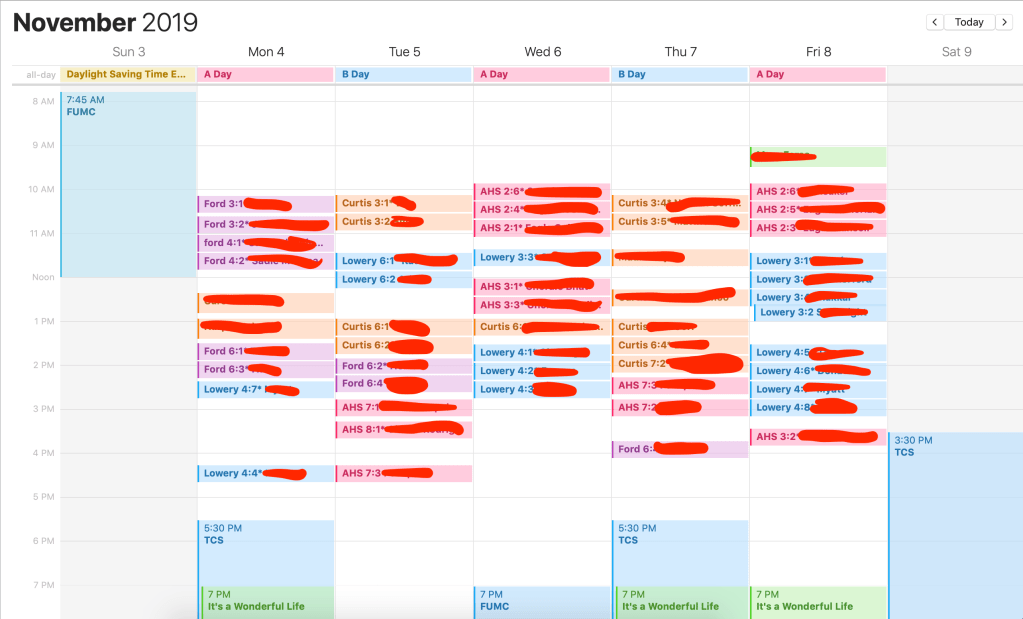
I started the year by quitting my job. Don’t worry- I have three of them, and for a long time I’ve needed all three of them to stay afloat. My typical schedule looks a bit like this:

You’d think that with all the hours spent working, I would have a nice little nest squirrelled away for myself at the bank, but really I work three low paying jobs and have absolutely no free time, resulting in one of the worst work/life balances I have ever had. Combine that with the fact that I was referred to an accountant last year who screwed up my taxes so badly that they weren’t properly filed, and I’ve had just about my most miserable year on record. Imagine trying to keep all of this straight with only an hour each day to do it. Luckily I have a very sweet and supportive Fiancé who makes sure that I eat enough and offers some healthy outside perspectives.

So I’ve decided that rather than keep a crappy job for a small amount of extra cash, I would rather use that time to answer the call I hear coming from my study, where my Graduate Degree sits on a shelf, gathering dust next to the piano that I can’t afford to tune until February. (It’s ok about the piano, I tell my students it’s post-modern tuning.)

I love opera so much that I chose to earn not one, but two degrees in singing, and I’m good at it. Good enough to get hired teaching voice at the biggest public high school in Texas. My students go to All-Region, sing the leads in musicals both at school and with outside companies, perform in cabaret nights, barber shop quartets, church choirs, independent talent shows, you name it. I help them prepare audition and performance material, I teach them how they should actually pronounce French, and I offer advice based on how I would handle certain auditions and performances, which is rich, considering that I did not book a single paying opera gig in 2019.

I felt the pangs of hypocrisy more and more as the year wore on, and blamed myself because I had no desire to even try to make new audition videos or email local conductors. I cancelled my YAPTracker subscription because I think it’s stupid to expect graduate level professionals to pay someone else to allow them to sing a role, thus missing out on opportunities that might have actually helped me. I spent less time on local audition websites and expected opportunities to somehow land in my lap. Thank the Lord for a friend in the area who cast me as Madame de la Grande Bouche (The Wardrobe) in Beauty and the Beast. I didn’t get paid for it, but at least I got to add a role to the resume which is relevant to my professional goals. And it’s not like I haven’t done anything at all- I’ve performed all year. Bells are Ringing, Mama Mia, Beauty and the Beast, It’s a Wonderful Life, various Opera on Tap performances. So I have auditioned, and I have been cast, just not for anything related to opera (and not for anything that paid). I had so much fun in music theatre this year that I could almost tune out the sound of my previous operatic aspirations.

However, much like Queen Elsa in Frozen Two, the siren has become so persistent that I have to address it.  My Fiancé left for the nightshift just before six, and after a kiss goodbye, I sat at the kitchen counter updating an excel document with our wedding details. Our cat, Maeve, looked on with interest for three whole minutes before walking straight across my keyboard, hopping off of the island, and pawing at the sliding doors to my study. Usually she does this when she’s gotten a toy wedged under the door. I opened the offensive thing for her, and no toy immediately visible, I turned on the light. There it was. Her favorite cat nipped stuffed gingerbread shaped Christmas toy. Maeve loped in and immediately batted it into my bookshelf full of scores. I probably stared at them for ten full seconds while her mews of distress floated across the room. I went back out to the kitchen, and saved the excel sheet before closing my laptop.

After retrieving Catnip-Man, I spent this evening delving into the scores on my bookshelf, thinking how great it was that I even have a night off to do this, and recalling the last thing I had that resembled a five aria package. Considering the last good package I had is from when I finished grad school, I decided to toss the whole damn thing. I am 27 years old, and I am finally vocally secure enough to sing larger rep and not get laughed at. At least… I’m pretty sure. I know for certain that the arias that fit best when I was 24 are no longer my best selections. Haven’t had a voice lesson in two years, so hopefully we’ll be clearing that up shortly. Goodbye, Cherubino, Siebel, and Dorabella. Recently, I’ve been revisiting Charlotte, getting to know Delilah and Amneris, and I’m wiping the Carmen slate clean to learn it from the ground up. I even sent emails to schedule voice lessons, a task that has paralyzed me with fear for almost a year and a half. I updated my linked in profile. I googled ensembles in my area that might be open to receiving audition materials from a mezzo soprano, and made a list of what to send to each of them. I checked the Dallas Opera page for chorus auditions- I was too early. I almost cried tears of joy; I haven’t been early for anything, in any definition of the word, in nearly two years. I set a reminder to check again in a month.

I put my scores in a pile on my piano bench with the Verdi on top, because I do finally have another paying gig. I’m singing Amneris in scenes from Verdi’s Aida on February 14th with Diversitá Opera, and who doesn’t want to portray an Egyptian Princess? Good news, my preliminary run throughs have felt great in my voice! I apologized to the piano for not tuning it, begging it to hold on to the middle octave until February, and went to find a dusting cloth. I took my degrees off of the shelf, and made a dramatic show of wiping them off so that the cat would know I was serious. I put them on top of the piano where I can see them. I put tabs in my Aida score, and placed a pencil and highlighter within reach. I might not know what the rest of 2020 will bring, but February will see me contracted to perform Verdi for a check, and I have a feeling that if I reinvest the time I spent at that retail job into my singing, there will be more to come.

The Met Hates my Pants.

This past weekend, I competed in the Tulsa District Metropolitan Opera National Council Auditions. For those of you who aren’t familiar, this is a nation wide competition open to individuals between the ages of 20 and 30. You pay $30 to apply, and if they like your resume, and have room for you, you get to show up with five arias and compete. You pick your first piece, the judges pick a second from a list you provide. After they have heard everyone, sometimes up to 40 singers, they announce three winners, and assign two encouragement awards. The winners move on to the next round of the competition. After the awards ceremony, you get to speak with the judges and receive feedback about your performance.

Team, I am not going to lie to you. I may not have moved on this past weekend at the Met Council Auditions, but I nailed that performance. I sang Nobles Seigneurs, Salut! from Meyerbeer’s opera, Les Huguenots. My coloratura was spotless, in the center of the pitch, well connected, and sassy. Except for N’eutant de gloire ni de bonheur, which I butchered by taking a breath too shallow to support the melismas. In the heat of performance, all you can do is think, “well, Self, that just happened. Remember to breathe this time.” I made a quick recovery, delightfully portraying a young page boy drunk with his first dose of power. My character, Urbain, peacocks about as he lauds his knowledge of very valuable information in front a large group of knights and lords. I like to imagine he has a big feather on his hat. Perhaps his jacket is a little too loud.

I like singing pants roles. I didn’t always, but I do now. I love when women get to portray men and boys on stage because it always sparks interesting conversation about character dynamics, and in my opinion, trouser mezzos get to sing some of the best music. Cherubino, Siebel, Nicklausse, and Sesto, to name a few, may be secondary characters, but their music absolutely steals shows. Best of all, these characters don’t have to walk around corseted, coiffed, and stuffed into a period style dress. Don’t get me wrong, I love elaborate costumes, but it is always a relief to know that you’ll get to do the show in flats and pants.

When I decided weeks ago that I would begin with Nobles Seigneurs, I also decided that I would be wearing trousers to my audition. Most women in opera show up in a jewel toned wrap dress. Usually a sheath or pencil skirt fit, occasionally A-line. Most women in opera are sopranos. They sing prima donnas, heroines, damsels, and love interests. I myself, happen to be a mezzo. I play the best friend, the younger sister, the scary aunt, or the young male. Since mezzos frequently perform in pants, we are allowed to audition in pants, and kids, the outfit I picked was a stunner. Straight-leg-cropped-above-the-ankle black trousers, strappy yet closed toe stilettos, and a pink champagne silk blouse. Made sure my belt matched. Made sure my jewelry was tasteful and understated. Natural makeup. Hair styled down, because although I’d be portraying a young boy, I still wanted to appear feminine. Trust me, a lot of thought went into this outfit. I wanted to look the part so that they would remember not my appearance, but my singing.

So you can imagine my utter despair when, upon sitting down with the male judge to discuss my musical performance, the first thing he said to me was,

“I see what you’re trying to do with the pants look, but it just doesn’t work. Leggings are not generally appropriate for auditions at this level. I could see your breathe mechanism working, and honestly it was distracting.”

First. My pants were absolutely no where near tight enough to be mistaken for leggings by any reasonable person. These pants in particular are indeed fitted, but let’s pause and consider the origin of the pants role. In the 1780’s, one never, ever, saw a respectable woman in public wearing anything besides skirts and petticoats. The entire reason composers began writing male characters for female voices is because the public wanted a place to see a cute girl’s legs without being shamed for it. If the girl wearing breeches was on stage, that didn’t make you a creep. I happen to be a solid 8/10, so you are welcome for the literal and metaphorical respects I am paying the root of pants roles with my outfit.

Second. I am not an idiot. I would literally never dream of wearing LEGGINGS to the Met Council. I’m bold, but certainly not that bold. The truth is, it was 23 degrees and windy outside. I regret nothing. Except for my butchered melisma, which has nothing to do with the way I was dressed.

Third. This man was in his late 50’s. Very successful in the industry, but he doesn’t even remember my name. To take it a step further, he doesn’t even remember my contestant number. (It was 17). His phrase, “I see what you are trying to do” insinuates several things, primarily that he doesn’t think I have the body type to wear what I wore. It also implies that my appearance is more important that my performance, since this was the very first thing he chose to say to me. My body type is none of your business, Sir. I look professional and I feel great in this outfit, so this was an opinion better kept to yourself.

Lastly. The notion that one should not be able to see a singer breathe is absurd, ludicrous, and baffling. All of opera is focused around maximizing the efficiency of air flow while creating an ideal space for resonance to occur. This is how singers are able to reach the back of a 1,000 seat house over a full orchestra, with no amplification. My trousers were mid-rise. I’m sure one probably could see my tummy moving around a little bit as I inhaled enough air to sing a ~*flawless*~ high C. One could probably see it collapse as I used the air. The judge probably saw it expand the next time I inhaled. But he was sitting half way back in a house of 500 seats. I was on a black stage wearing black pants. I’m an acceptable weight for my frame, which means that this judge had to actively seek this area of my body out to comment on it.

Perhaps this judge was truly trying to be helpful. I would absolutely have received this comment differently coming from a woman, but in the end, the opera world still has a long way to go. I paid $30, spent six years in school, and drove four hours from Texas to compete in one of the most prestigious singing competitions in the country, not a beauty pageant. Next time I compete at the Met Council, I will probably still wear pants. I hope whoever is judging next year will feel that my singing is important enough to warrant their first comment, because while appearances still matter in the opera world, I would really like to have known how to control my breath on that particular melisma.